By Sophie Braithwaite
This OT Week, the theme is Participation Changes Everything. I agree, and I've loved seeing the profession celebrate itself all week. But as an occupational therapist and a disabled woman, I want to ask a harder question: who decides what participation looks like?
Earlier this year, my MSc in Disability Studies asked us to look at how disabled people's participation is enabled or inhibited. Much of the discussion turned to OT and other allied health professions. Honestly, exploring this other side of OT made me anxious. I'd spent my whole BSc building pride in my profession. But I've come to believe that pride means being willing to ask where we might not always be enablers, and what it takes to be true allies. This blog draws on the paper I wrote for that module.
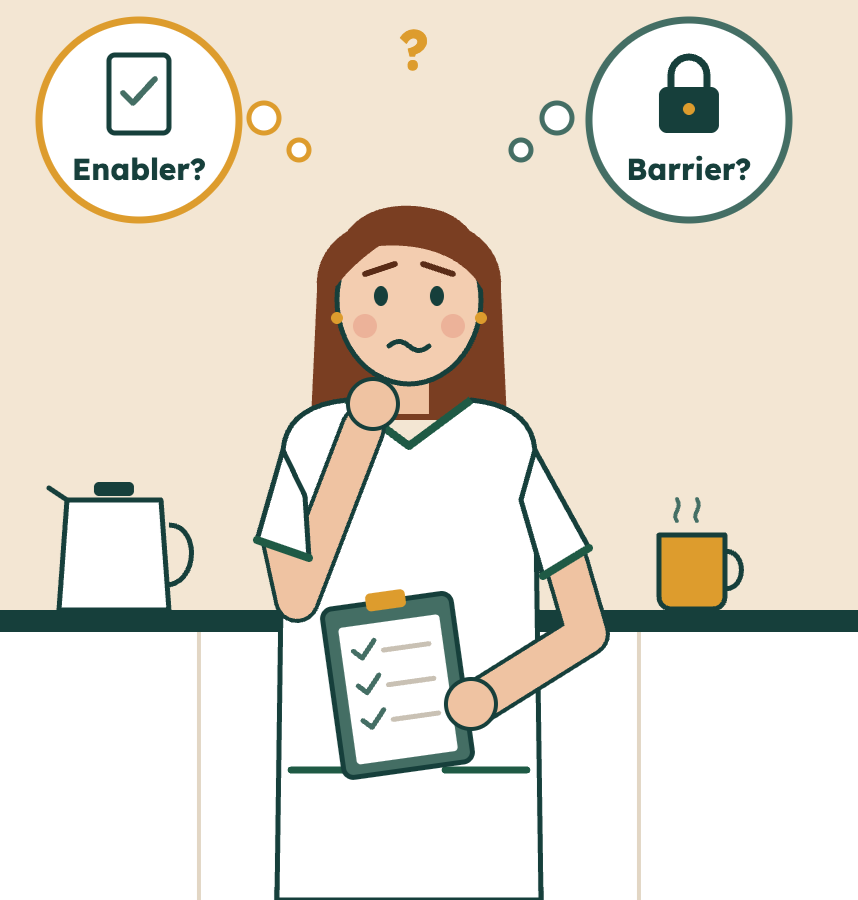
For many disabled people, OT is genuinely enabling. In some settings, though, we can end up being part of the barrier. I'm writing this as one of us, not to blame individual OTs. It's about the systems we work in, and the tools we've inherited.
Independence isn't the same as function
The disabled people's movement defines independent living as having the same choice, control and freedom over your life as anyone else. That covers where you live, who supports you and how you take part in your community.
It isn't about doing everything yourself.
It's a rights-based idea, set out in the UN Convention on the Rights of Persons with Disabilities (CRPD):
Article 12: the right to make your own decisions, with support if needed
Article 14: the right to liberty, not to be detained because of disability
Article 19: the right to live independently and be included in the community
OT has historically measured independence differently: by whether someone can wash, dress or cook. Those skills matter. But function and freedom are not the same thing.
Where the tension is sharpest: acute mental health
On acute mental health wards, people can be detained and treated without consent under the Mental Health Act. Detention rates at least trebled between the 1980s and 2016 (Keown et al. 2018). In 2025-26, NHS England recorded 56,461 new detentions, though NHS England notes its data may not be complete (NHS England Digital, 2026).
The new Mental Health Act 2025 raises the bar for detention with a “serious harm” test, and brings in statutory care and treatment plans (Kennedys, 2026). But most changes won’t start until 2027, and the core power to detain remains. The UN CRPD Committee states that Article 14 “does not permit any exceptions whereby persons may be detained on the grounds of their actual or perceived impairment” (Guidelines on Article 14, UN 2015, published in A/72/55).
This is where safety and risk management most often outweigh choice and control. And OTs work right in the middle of it.
Is client-centred practice sometimes tokenism?
We pride ourselves on being client-centred. But at times it can slide into tokenism.
Arnstein's ladder of participation (1969) is useful here. It separates being informed or consulted from actually holding power. A person may tell us they want to go home. We listen, we note it in the care plan, but the decision still sits with us and the team.
In practice, this can look like a ward round where the person’s wishes are written down, but the team makes the decision. Our assessments and clinical language can end up carrying more weight than the person’s own account of their life.
So when we point to “functional deficits” to justify an outcome like supported living, the person is being decided for, not supported to decide. Participation becomes part of the ward routine, rather than real power.
I want to be fair here. OTs on acute wards work with tight staffing, a strong risk culture and legal duties we can’t simply ignore. Many already push back every day. This isn’t about blaming individuals. It’s about noticing where the system, and sometimes our own tools, quietly take power away.
Access from outside, power from inside
This week AbleOTUK published a powerful open letter on Access to Work. They show how delays and broken support block disabled people, including disabled OTs, from taking part in work. As they put it: "Participation changes everything, but access makes participation possible."
I want to build on that. AbleOTUK shows how systems can block participation from the outside. My question is how it can also be blocked from the inside: in our own practice, assessments and decisions.
Both point to the same truth. Participation isn't something we hand out. It depends on access, rights and power.
From enabler of the institution to ally of the person
So what can we do? We have a choice about whose independence we’re measuring. Even within the limits of an acute ward, we can:
Measure independence by choice and control, not just function.
Uphold the dignity of risk (Perske 1972), including the right to make unwise decisions under the Mental Capacity Act 2005.
Practise supported decision-making, not substituted decision-making.
Be honest about power with the people we work with, rather than hiding it behind client-centred language.
Learn from the disabled people's movement: the social model, independent living and nothing about us without us.
Participation changes everything. But only when the person holds the power.
Over to you: where have you seen participation turn into tokenism, and what helped you push back? And please read and share AbleOTUK's letter.